As camera prices continue to fall, an increasing amount of professionals are discovering that having multiple, synchronized angles truly makes editing alot quicker and smoother. A multi-camera shoot can save enormous amounts of time and money during post production and so is becoming a popular choice with production companies across the world.
The Untied States continued using single cam's during this time was predominant until a 'Hybrid' style of production evolved. This consisted of inserts filmed with a single cam, largely filmed on location. These shots were then mixed with interior scenes shot on a multi cam setup inside a studio, this method is still largely used by ITV and the BBC and can be seen in television shows such as Coronation Street and Eastenders today.
As technology began to develop ever quicker, productions shot on location began to use a multi electronic camera setup and this held true for ongoing soap-opera shows. Prime time television dramas were and still are largely shot on single cam's due to being cheaper and more efficient in the studio.
Mutli-Cam VS Single Cam
For a talking head, tour of a complex, instructional video etc a single camera productions is the most effective method of filming,. Things like stop/start filming, short segments or location changes are all best suited to being filmed with a single camera.
To cover live performances, chat shows, theater work or anything lengthy or anything that involves filming something that cannot be repeated e.g sporting events, feats of wonder etc is best filmed on a multi-camera setup.
A multi cam production is a far more engaging and interesting production to watch that a single cam production. Multi-cam work is like most television shows that people would watch, eg The Big Bang Theory or Two and a Half Men, there are many different points of view throughout the show that can all be filmed at once. Whereas a single camera can only show one point of view at any one point. To change viewpoint means you have to stop and start recording as you move camera and re-set it (all this while running the risk of missing something valuable). The only alternative is to have the camera on a dolly in which case you can see the camera moving around and may not give the desired professionalism.
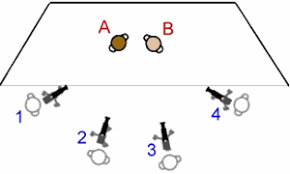
Mutli-Cam productions are made by filming with a number of independent cameras then editing all the footage together or live-switching between the camera's (on location) with a vision mixer. All the cameras are cabled together and centrally controlled by both a vision mixer and a director to decide the shots.
Independent filming using a multicam set up can be more expensive because of all the post-production editing time (the length of the show, multiplied by how many cameras you have, plus the time to edit.) Live-switching with a mulicam production is virtually edited as you go along, so the production is essentially finished at the end of filming, with the added bonus of the director controlling what the cameras are doing while they are filming, making sure all the shots are in order and co-ordinated.
You can produce a live-switched multicam production for roughly the same cost as a single cam, sometimes cheaper and certainly faster. A live-swtiched multi cam production costs are easy to work out from the beginning, it is essentially going to cost whatever your going to do on the day. (set up, film, pack up, transportation and materials) Since there is generally not alot of editing to be done afterwards. Alternatively in a single cam production theres a lot of editing involved, alot of the time its hard to estimate how long the editing will take. More often than not the editing is a long a tedious process often several times longer than the actual footage itself. For example:

- Watching through the unedited material deciding which clips to use. (This takes a bit longer than all your footage combined.)
- Editing the clips together (this takes as long as each clip plus the time to tidy each edit.)
- Checking the smoothness of the entire edit as you go along.
- And then sound editing, which is done independently of the video editing. But still takes just as long as each clip and thus creates a long winded process.

Almost all filming takes a certain degree of editing and this needs to be taken in to account when deciding the best way to film. Single camera work involves editing every shot taken as well as the sound. Mutlicam involved the same, multiplied by your amount of cameras. Whereas live-switch multicam's involve little more than VT's involved and credits either side of the show, which is possible to do live. Editing in the middle of the production shouldn't be necessary unless something goes wrong. So in summary if you filmed for a day with a single cam production you would be editing for roughly 1/2 days. A multicam production, filming for a day would result in roughly a week of editing. Compared to a live-switch multicam production which is roughly a day of filming and very little editing.

Looking at The Big Bang theory, a multi camera production, you can see the wide variety of angles put to use. Alot of mid shots are used mainly due to the fact that more often than not the scene is a group scene featuring multiple people and diverse settings. They also use alot of wide angle panning shots to establish the scene setting. The sets they use are regular features. Spanning from the protagonists apartments to the comic book store, as well as the university (their place of work). Also they use an awful lot of close ups as alot of the actors, especially Sheldon, convey alot of their performance through their facial expressions, making close ups a must. One thing that i feel should be noticed is the fact that the show is always shot from one direction. This is due to the fact that the entirety of the set is shot in studio setting and thus physically could not be firmed from any other directions.
I think the reason that this show is a multi cam is due to the fact that a) its a comedy, so having multiple cameras will enable the production team to capture whatever unplanned/unscripted parts happens in a wide variety of angles and a much higher likelihood of capturing a usable "improv" moment. b) The fact that its a comedy show almost necessitate's the need for a multi cam. Having a number of different cameras at a number of different angles means the cast can just cleanly run through the scene and thus makes the jokes a lot smoother and a lot more like real life. Opposed to single cams where you would have to consistently be stopping and starting and there would be no sense of naturalism regarding the jokes told in the show.
Advantages
- More camera shots in a shorter space of time - this is acheived by having more cameras recording at any one point. This removes the need for scene repeats in order to get different angles.
- Flow of the show - because there is a number of cameras recording one scene the realism of the dialogue appears a lot greater because there isnt the need to cut different angles of the same dialogue together to create variation. All the dialogue is from one take. This makes the smoothness of the entire show increase dramatically.
- More shots to edit with - by using multiple cameras you get multiple shots and angles of everything that happens. This gives you an awful lot more room to work with when it comes to post production editing. Compared to single cam where you have a much more acute range of shots to work with.
- Audience involvement - one of the biggest problems with multi-cams is the perceived "canned laughter" This was an issue created by journalists and critics who were initially opposed to multi cam productions. It makes it very difficult to report that something isnt funny when you have a room full of people rolling in laughter that directly contradicts that. Audience involvement tells the viewer when they should be laughing and what exactly is funny. This increases the amount the audience at home actually laughs at the show. Having laughter already fixed to the show as a track is actually a very useful convention for convincing the audience at home that these things are funny. Sub-consciously we react to this stimuli.
Disadvantages
- Cameras/equipment could get in the way of shots - with more equipment comes more risk. You need to have all this equipment wired up, something that is a huge risk on a set. You also have to find a way to make these cameras moveable without getting in one anothers way. But more importantly you have to make sure none of this extra equipment gets in shot.
- Lighting - With increased view from all the cameras you have to make sure that the lighting is exactly the same regardless of what area or angle you are shooting form. This can be extremely difficult and is something that has to be well planned and thought through when creating a multi cam project.
- More cameras, more organisation - With a single cam production all you have to worry about is the one angle you want to be shooting from. When using a multi cam production you have to plan extensively exactly what each camera will be shooting. This ties in to the discussion above. If you have a multi cam set up of 4 cameras, that means you need to have 4 shot lists for each camera. 4x the camrea = 4x the work.
- More hazards - see above.
- Communication - see above.

This is a close up shot from a multi cam production.

This is a mid shot from a multi cam production.

This a wide angle shot from a multi cam production.

No comments:
Post a Comment